


Started in 1980s, Zhengzhou Unique Industrial Equipment Co., Ltd (Unique Group) is already a famous manufacturer & developer of mining equipment like stone crushing & screening equipment and ore processing equipment in China. Our products scope mainly includes cone crusher, jaw crusher, impact crusher, sand making machine, vibrating screen, vibrating feeder, belt conveyor, stationary & mobile stone crushing plant, ball mill, magnetic separator and cement production line etc.
A 100 TPH mobile crushing plant is a practical solution for mining companies, quarry operators, aggregate producers, road construction contractors, and construction waste recycling projects that need to process stone and other mineral materials close to the working site. Unlike a traditional stationary crushing plant, a mobile crushing plant integrates the main crushing and screening equipment on a mobile chassis, allowing the production system to be relocated according to project requirements.
For projects with a target capacity of approximately 100 tons per hour, the crushing plant can be configured with primary crushing, secondary crushing, and screening equipment. The UNIQUEMAC configuration described in this solution combines a GZT0826 vibrating feeder, PE500×750 jaw crusher, PSGB0917 Symons cone crusher, and vibrating screen to form an integrated mobile crushing and screening system.
It is important to understand that the actual production capacity of a 100 TPH mobile crushing plant depends on several factors, including the type of raw material, maximum feed size, material hardness, moisture content, crusher settings, final product size, and feeding conditions. Therefore, the equipment configuration should be selected according to the specific requirements of each project rather than capacity alone.
In the crushing and screening industry, TPH means tons per hour. Therefore, a 100 TPH mobile crushing plant is a mobile crushing and screening system designed around a nominal processing capacity of approximately 100 tons of material per hour under suitable operating conditions.
The term “100 TPH” does not mean that the plant will always produce exactly 100 tons per hour regardless of the material or operating conditions. Harder rock, oversized feed material, high moisture content, irregular feeding, and smaller final product requirements can all affect the actual throughput of the crushing plant.
A typical mobile aggregate crushing process can be arranged as follows: Raw Material → Vibrating Feeder → Jaw Crusher → Cone Crusher → Vibrating Screen → Finished Aggregates. This process allows the plant to perform primary crushing, secondary crushing, and material classification within an integrated production system.
For contractors and aggregate producers working on quarrying, mining, road construction, or construction waste recycling projects, a mobile crushing plant can bring the crushing process closer to the material source or the location where the finished aggregates are required.
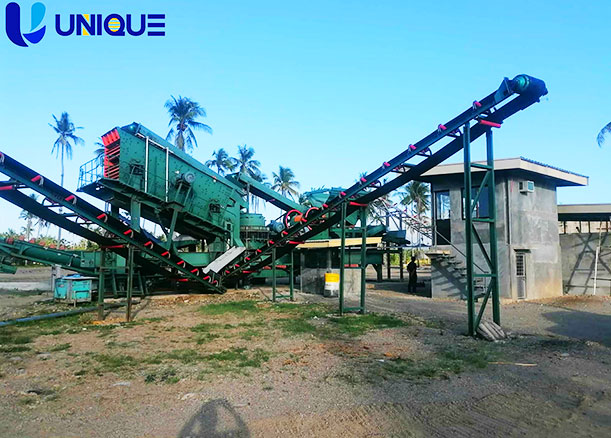
The equipment configuration has a direct influence on the capacity, product size, particle shape, and overall performance of a crushing plant. The UNIQUEMAC 100 TPH configuration described in this solution consists of a vibrating feeder, jaw crusher, Symons cone crusher, and vibrating screen.
The GZT0826 vibrating feeder is installed at the beginning of the crushing process. Its primary function is to receive raw material and feed it continuously and evenly into the jaw crusher.
Stable feeding is important because an uneven material flow can cause fluctuations in crusher load and affect the overall efficiency of the crushing circuit. A properly selected feeder helps maintain a consistent supply of material to the primary crusher.
The vibrating feeder in this configuration is designed to provide a continuous flow of stone or other suitable feed materials to the primary crushing stage. It also helps control the material flow before the raw material enters the jaw crusher.
The PE500×750 jaw crusher serves as the primary crusher in the 100 TPH mobile crushing plant. Its main function is to reduce large rocks into smaller pieces before the material enters the secondary crushing stage.
The raw material is compressed between the fixed jaw and movable jaw inside the crushing chamber. This compression process reduces oversized rocks to a more manageable size for further processing by the cone crusher.
According to the supplied equipment information, the PE500×750 features a relatively large feed opening and deep crushing chamber. The provided specification also indicates that it can be used for hard materials such as granite and basalt, with a stated material compressive strength capability of up to 300 MPa under the specified conditions.
In a complete crushing plant, the jaw crusher plays an important role because its output directly affects the feed conditions of the secondary crusher.
After primary crushing, the material enters the PSGB0917 Symons cone crusher for secondary crushing. This stage further reduces the material size and helps produce aggregates that are closer to the required final specifications.
A cone crusher uses compression between the mantle and concave to reduce the size of the material. This crushing principle is suitable for applications where controlled product sizing and suitable particle shape are important.
The supplied configuration uses a laminated crushing principle to improve crushing efficiency and particle characteristics. The cone crusher works as the secondary crushing equipment after the jaw crusher, creating a two-stage crushing process.
The combination of a jaw crusher and cone crusher is commonly used when a project requires progressive size reduction and better control over the final aggregate gradation.
After secondary crushing, the processed material enters the vibrating screen. The main function of the screen is to classify crushed material according to particle size.
A multi-layer vibrating screen can separate the crushed material into several different size fractions. This makes it possible to produce multiple aggregate specifications from the same crushing and screening line, depending on the screen configuration and project requirements.
When a closed-circuit configuration is required, oversized particles can be returned to the crushing circuit for further processing, while material that meets the required size can be discharged as finished aggregate.
The working process of a 100 TPH mobile crushing plant can be divided into several stages. Each machine performs a specific function, while the feeder, crushers, and screen work together as a complete production system.
Raw material is normally loaded into the vibrating feeder using an excavator, wheel loader, or other suitable loading equipment. The feeder controls the material flow and transfers the raw material continuously toward the jaw crusher.
The jaw crusher reduces the initial size of the raw material. This stage is particularly important in quarrying and mining applications because the feed material may arrive at the plant in relatively large sizes.
Effective primary crushing prepares the material for the secondary crushing stage and creates more suitable feed conditions for the cone crusher.
Material discharged from the jaw crusher enters the Symons cone crusher for secondary crushing. At this stage, the particles are reduced further and brought closer to the required final product size.
The operating settings of the cone crusher should be selected according to the material characteristics, feed size, required capacity, and final product specifications.
After secondary crushing, the material enters the vibrating screen. The screen separates the crushed material into different size fractions according to the required product specifications.
Depending on the project requirements, different screening configurations can be used to produce several finished aggregate sizes. This stage is particularly important for road construction and commercial aggregate production, where final particle size and gradation are important.
The materials suitable for a mobile crushing plant depend on the selected equipment configuration and the physical characteristics of the raw material. The UNIQUEMAC configuration described in this solution covers applications involving stone, construction materials, granite, basalt, and aggregate production.
Typical materials that may be considered include granite, basalt, limestone, various quarry rocks, and suitable mineral-based construction waste. The actual suitability of the equipment should be confirmed according to the specific material characteristics and project conditions.
Before selecting the crushing equipment, it is recommended to evaluate material hardness, abrasiveness, moisture content, maximum feed size, and required final products. These parameters help determine whether a jaw crusher, cone crusher, or another crushing configuration is suitable for the application.
Mobile crushing plants for aggregate production can be used in quarrying operations to process rock close to the extraction area. By reducing the distance between the raw material source and the crushing system, a project may reduce the amount of unprocessed material that needs to be transported to a stationary crushing facility.
The mobile configuration can also be useful when the working area of a quarry changes gradually during the development of the site.
Road construction projects require different types and sizes of aggregates for applications such as road base, sub-base, and other construction layers. A mobile crushing plant can be positioned close to the construction area to process suitable raw materials and produce the required aggregates.
The supplied application information identifies road infrastructure development as one of the potential applications of the 100 TPH mobile crushing plant.
Construction and demolition waste may contain concrete, masonry, and other mineral-based materials that can potentially be processed into recycled aggregates when the material composition and project requirements are suitable.
A mobile crushing plant for construction waste recycling allows the processing operation to be carried out closer to the location where the waste is generated. This can reduce the need to transport large volumes of bulky waste to an external processing facility.
In certain mining projects, a mobile crushing plant can be moved closer to the extraction area. This allows primary crushing to take place closer to the material source and may reduce internal transportation distances.
The supplied project information identifies mining operations and on-site crushing as one of the potential application areas for the 100 TPH mobile crushing solution.
The main difference between a mobile crushing plant and a stationary crushing plant is installation and relocation flexibility. A stationary crushing plant normally requires a dedicated installation area and supporting infrastructure, while a mobile plant is designed to be transported between different working locations.
The UNIQUEMAC configuration described in this solution uses a heavy-duty mobile chassis and tire-based design, allowing the equipment to be transported without completely dismantling the main crushing system.
This feature can be useful for short- and medium-term projects, road construction projects, quarry operations with changing working areas, aggregate production at multiple locations, and certain construction waste recycling projects.
The main value of a mobile crushing plant is not simply its ability to move. More importantly, it allows the crushing process to be brought closer to the location where the raw material is available or where finished aggregates are required.
When selecting a 100 TPH mobile crushing plant, buyers should not evaluate the equipment based only on its nominal capacity. Actual production can be affected by several operating conditions.
The maximum feed size directly affects the selection of the primary crusher. If the raw material is too large for the available feed opening, additional size reduction may be required before the material enters the crushing plant.
Material hardness affects crushing energy requirements, throughput, and wear of the crushing components. Hard and abrasive materials may require different equipment configurations and appropriate wear-resistant parts.
High moisture content can affect feeding and screening performance, particularly when the material contains a high percentage of fines or has sticky characteristics.
The required final product size also influences plant capacity. A project that requires finer aggregate may require more crushing and screening work than a project producing relatively coarse aggregate.
Continuous and uniform feeding helps maintain a stable operating load on the crushers. Frequent interruptions or irregular feeding can reduce the overall utilization of the crushing plant.
For this reason, the configuration of a 100 TPH mobile crushing plant should be determined by considering the raw material, maximum feed size, required capacity, final product sizes, and actual working conditions together.
One of the advantages of combining secondary crushing and screening is the ability to classify material into different sizes. Depending on the customer’s requirements, a crushing plant can be designed to produce several aggregate fractions.
For example, a project may require products such as 0–5 mm, 5–10 mm, 10–20 mm, and 20–30 mm. The actual product sizes and screen configuration should be determined according to the specific requirements of the project.
A multi-layer vibrating screen can separate different material fractions after crushing. The number and size of the finished products depend on the screen configuration and the specifications required by the customer.
UNIQUEMAC provides crushing and screening equipment and solutions for mining, quarrying, aggregate production, construction, and infrastructure applications.
The 100 TPH mobile crushing plant configuration described in this solution combines a GZT0826 vibrating feeder, PE500×750 jaw crusher, PSGB0917 Symons cone crusher, and vibrating screen to form an integrated mobile crushing and screening system.
The equipment configuration can be selected according to the characteristics of the raw material and the required finished products. Crusher selection, operating settings, screening specifications, and the overall process should be evaluated according to the actual project conditions.
According to the supplied company information, UNIQUEMAC also provides services related to equipment customization, installation, and technical support to help customers develop suitable crushing solutions for their projects.
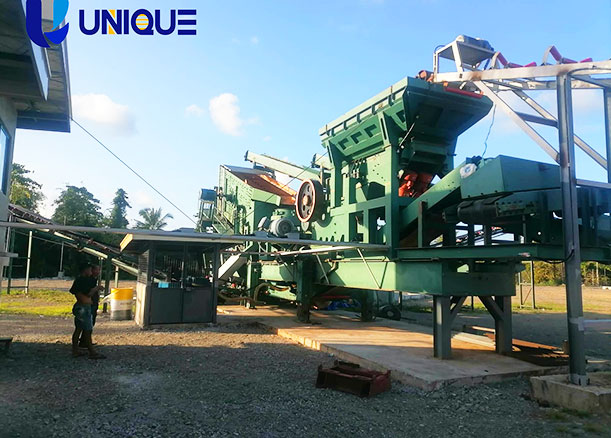
100 TPH means approximately 100 tons per hour. It is a nominal capacity reference under specific operating conditions. Actual production depends on the material type, feed size, equipment configuration, final product size, and operating conditions.
The configuration described in this solution includes a GZT0826 vibrating feeder, PE500×750 jaw crusher, PSGB0917 Symons cone crusher, and vibrating screen.
The supplied equipment information identifies granite and basalt among the hard materials that can be processed by the PE500×750 jaw crusher. However, the final configuration should be confirmed according to the specific granite characteristics, feed size, abrasiveness, required capacity, and final products.
Yes. The vibrating screen can classify crushed material into different size fractions. The number and size of the finished products depend on the screening configuration and the customer’s requirements.
A mobile crushing plant can be used for road construction projects when suitable raw materials are available and aggregates need to be produced close to the construction area. The supplied project information identifies road infrastructure development as one of the potential applications of this crushing solution.
When selecting a 100 TPH mobile crushing plant, it is recommended to provide information about the raw material, maximum feed size, required capacity, final product sizes, number of finished products, material hardness, abrasiveness, expected operating conditions, and relocation requirements.
With this information, the manufacturer can analyze the crushing process and select a suitable equipment configuration according to the specific project requirements.
A 100 TPH mobile crushing plant is not simply a combination of several machines mounted on a mobile chassis. The performance of the complete system depends on how the feeder, primary crusher, secondary crusher, and screening equipment work together.
If you are planning an aggregate production, quarrying, mining, road construction, or construction waste recycling project, you can send UNIQUEMAC the following information: raw material + maximum feed size + required capacity + final product sizes + number of finished products.
Based on this information, our technical team can evaluate the project conditions and provide a suitable 100 TPH mobile crushing plant configuration, together with a technical proposal and quotation.